

November 15 was my parents’ anniversary.
I’ve been thinking about how much there is behind a single moment.
Their anniversary is one date, but behind it are their childhoods, their families, their meeting, and everything that brought them together. Beyond it is everything that followed: the life they created, their children, and the memories they left behind.
One moment in a much larger story. It has a shadow.
I’ve been exploring this idea through something as ordinary as a couch.
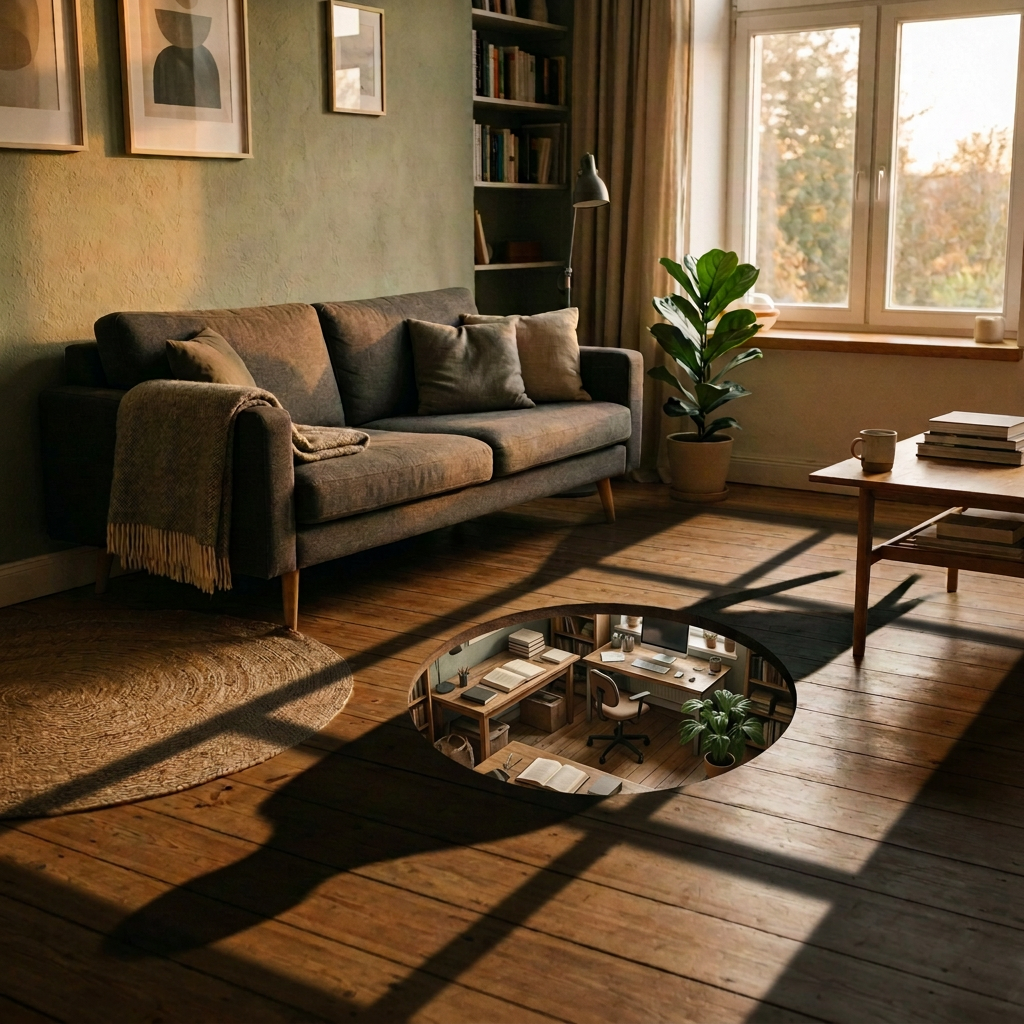
When I look at the couch, I see its illuminated surfaces, but it also blocks my view of the carpet and wall behind it. It reveals something while concealing something else. If I change my position, what was hidden becomes visible.
Nothing in the room has changed. My perspective has.
The same is true of time and emotions. An event has a history behind it and consequences extending beyond it. Irritation, for example, may conceal an expectation, a memory, or a physical sensation that we haven’t yet noticed.
What we see is not all there is.
But there’s another dimension to this idea that interests me even more.
What if the shadow also has something to do with what we think we already know?
We encounter something, and almost immediately our minds identify it. We name it, associate it with something familiar, and decide what it means. Our accumulated knowledge fills in the picture before we’ve had much opportunity to experience it.
We think we know what we’re looking at.
Perhaps the gap is a separation from everything we think we already know.
Not a rejection of knowledge or an attempt to forget what we’ve learned. Just a little space between our immediate experience and the interpretation that follows it.
What if, instead of immediately deciding what something means, we allowed ourselves to remain curious?
What else is there?
Consider irritation. You notice that you’re irritated, and almost immediately you begin thinking about what to do with it. You want to change your mood, resolve the situation, or move on to something more pleasant.
But what if you stayed with the irritation?
You might notice a tightness in your body. That sensation might remind you of another experience. That experience might bring up a memory, a thought, or an unexpected feeling.
You haven’t tried to change the irritation. You’ve simply given it some space.
And in that space, something else becomes visible.
This is one of the reasons I developed Sketch Stretching. A sketch doesn’t have to represent anything recognizable. It can be a line, a circle, a shape, or just a few marks on a page.
The point isn’t to make a picture. It’s to give your thoughts and feelings somewhere to go without having to explain or direct them.
Start with whatever has captured your attention. Make a sketch. Notice what comes to mind. Follow an association. Notice what you feel or what happens in your body. Let another thought or sketch emerge.
You don’t need to know where you’re going or what anything means. You’re simply giving yourself room to discover what happens next.
Perhaps that’s the real stretch: creating some distance between what you experience and what you think you know about it.
There is an interesting irony here.
We often approach happiness as something we need to find, achieve, or create. We look ahead to the moment when something will be resolved, completed, or made better.
But perhaps we overlook the happiness that is already happening while we explore an experience.
When we stop trying to change what we’re experiencing and instead become curious about it, unexpected things can emerge. A memory, a new association, a physical release, or simply a sense of openness.
Nothing had to be fixed.
The happiness wasn’t waiting at the end of the exploration. It was happening along the way.
So the next time you find yourself caught up in a thought, a feeling, or an experience, don’t be in such a hurry to move on.
Stay in the gap.
Give it some space.
See where it goes.
You might discover that what you thought was an empty space was actually where the experience of living was happening all along.
Perhaps happiness isn’t something we have to find. It’s how happiness is happening.


