

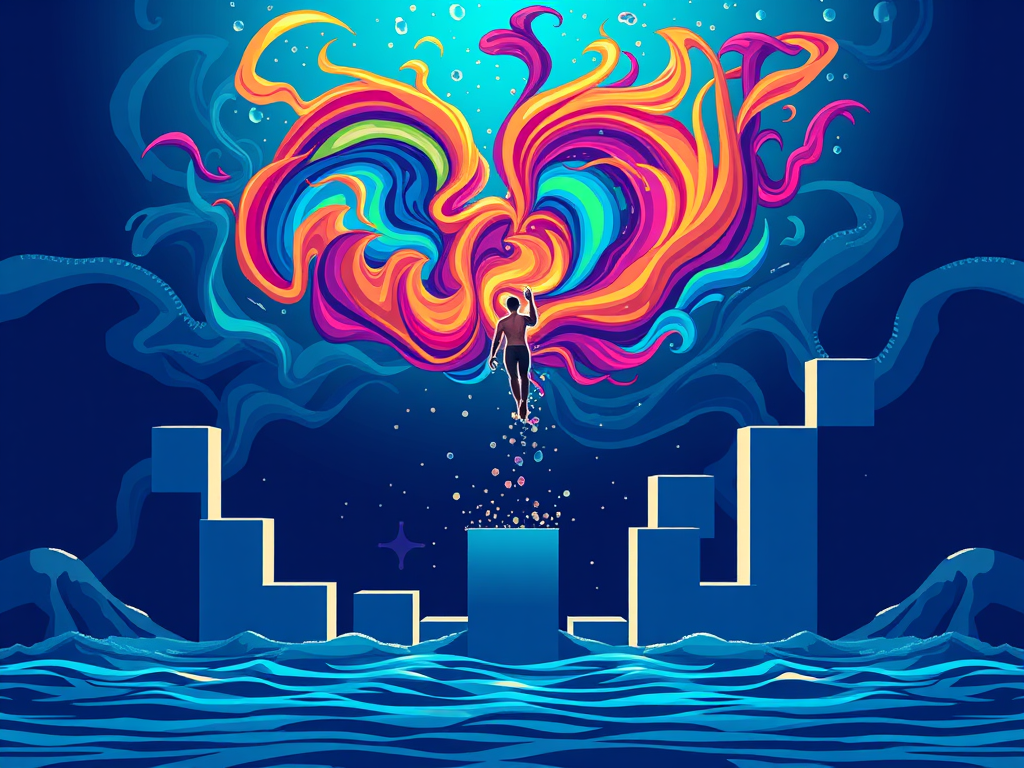
This morning, my body stood like a diver on the edge of my mind, toes curled around the rim of awareness. With a breath, it leapt—not outward, but inward—flipping in slow motion through the air of imagination, tumbling into the deep foundation of self. One full arc of motion, down into the center of being, and then up again, somersaulting to land back on the edge. Then again, this time not landing in the center but arcing to the far side—back and forth, in rhythm with the breath. Inhale, exhale. Each breath a movement, a bridge. The edges of thought and body held loosely in the swing.
Down in the foundation—beneath thoughts, below emotion, under identity—I glimpsed a field of blank thoughts. Not empty, but unformed. Thoughts like clear paint, waiting for pigment. Like unprinted pages or unplayed notes. Lego-like blocks of pure thought-potential. Each one waiting to be shaped into something specific by the coloring power of perception, memory, or intention.
Some of these blank blocks were magnetized. When clicked together, they didn’t just stick—they vibrated with a subtle hum, a current of coherence. I imagined a structure made entirely of these magnetic blocks: a tower, a body, a planet. And running through it—a single, unbroken line of energy, threading from the center of the Earth up through everything it holds. Trees, chairs, bodies, clouds. All aligned, not just by gravity’s pull, but by an inner resonance. As if gravity were not a force but a tuning—an invisible field harmonizing the shape of things.
This energy wasn’t loud. It wasn’t even visible. But it was there—like the buzz in your fingertips after holding something electric, or the still, thick silence just before thunder. It was the suggestion of becoming. The sense that what we see is not all there is.
And within this field, thought itself is not a fixed product but a process—starting blank, becoming colored. Meditation brings us back to that blankness. At first, we follow the breath, the sensations, the edges of awareness. But slowly, we descend to the place where thought arises before it becomes what we call “a thought.” Here, we find the raw material. Blank blocks. Undirected energy. Like stem cells of the psyche.
Just as mast cells in the body wait to become whatever is needed—a muscle, a nerve, a defense—these blank thoughts wait to become our beliefs, our reactions, our meanings. But most of the time, they’re shaped unconsciously—colored by memory, habit, unresolved emotion. Our personal histories reach in with their sticky fingers and tint what’s being born. A sound reminds us of a loss, and the blank thought takes the shape of grief. A smell brings comfort, and the block becomes nostalgia.
But what if we catch the thought before it forms? What if, through mindfulness, we witness the blank block while it’s still shimmering with potential? Then intention becomes a sculptor. Awareness becomes a dye. And we become participants in the shaping of mind—not victims of our past, but co-creators of the present.
To fish for thought in its unformed state is not to control the mind, but to greet it gently—like casting a line into a quiet lake, not knowing what you’ll pull up, but knowing the water is full. It is here—in the subtle flicker between sensation and meaning, between breath and reaction—that we find freedom.
And in that space, perhaps, we hear the hum of the Earth—not just gravity, but alignment. Not just the pull, but the pulse. A magnetic thread running through everything, whispering: you are not finished yet.

 Spiritual Gravity