

The Island of Happiness and the Raft We Forget We’re Holding
I’ve been circling around a few ideas, and today they seem to fold into each other.
There is a teaching image of using a raft to cross an ocean—the raft of impermanence, non-self, emptiness—to move through what is often called suffering. And then, once you reach the other shore, you don’t need to carry the raft anymore.
You set it down.
But then a question naturally arises:
Why would you ever need to pick it up again?
The answer that appears is unsettlingly simple:
Because you are still in motion.
It can feel like you reached the far shore, but later you notice you are again in the middle of water. So the raft returns. Or maybe it was never a single crossing at all, but a series of crossings—like stopping at islands that feel like arrival but are not final.
An island of happiness on the way to something ultimate.
And here the word ultimate begins to matter more than any specific name we give it—God, Nirvana, reality, truth. The mind reaches for something final, something complete, something that would end the search.
But every concept used to point there is still a concept.
And concepts behave like filters.
They shape what we think we are seeing.
It begins to feel like one concept being used to pry open another concept, like using one shell fragment to open another shell.
Or using a thorn to remove a thorn.
Useful, but still within the same system.
Then another image appears:
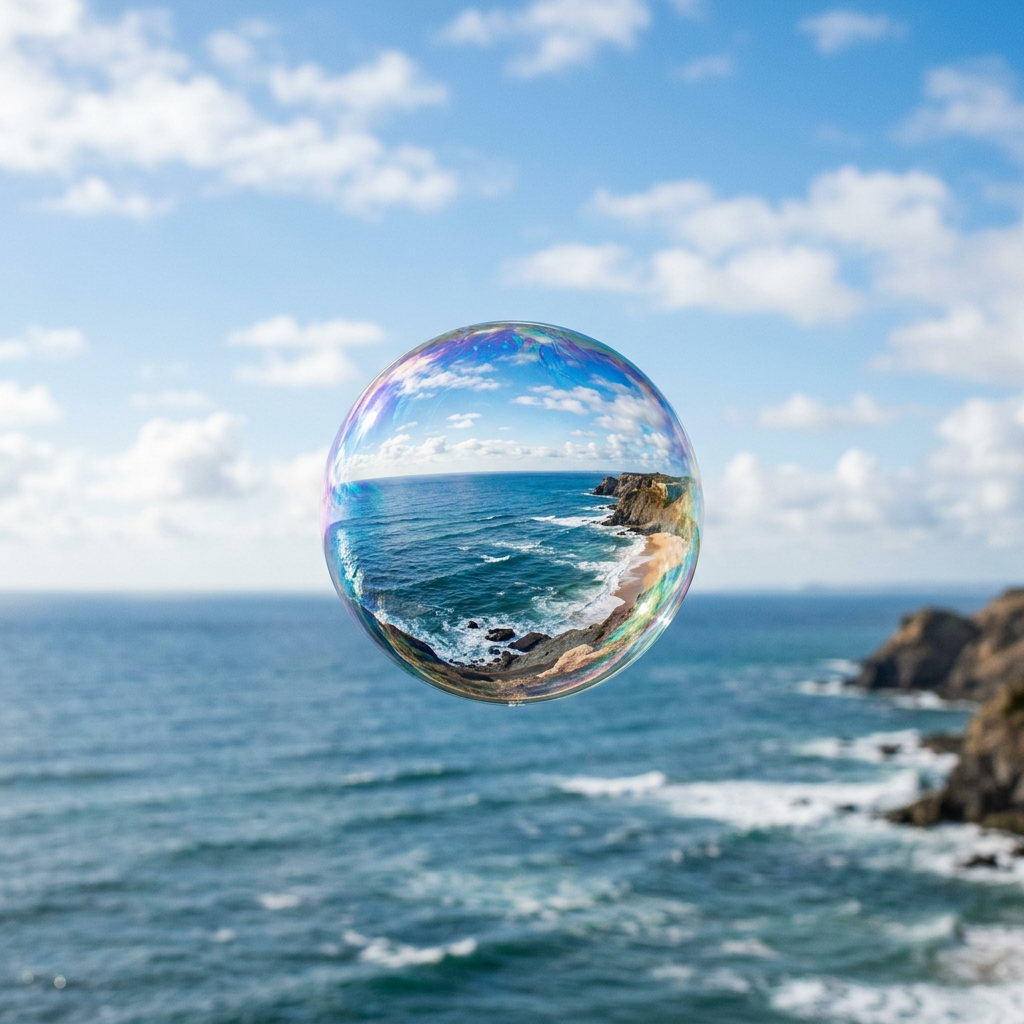
A soap bubble.
Inside and outside are different only by perception. The air is continuous. The separation is imagined by the boundary.
We think we are inside the bubble looking out at something different.
Or outside the bubble looking in at something contained.
But if the bubble bursts, nothing essential changes.
There is just air.
The distinction was never as real as it seemed.
And yet while the bubble is intact, it feels completely real. The boundary feels like identity. The inside feels separate from the outside. The self feels enclosed in its own version of reality.
So when we speak of realization, it sometimes sounds like a dramatic shift:
a recognition that I am the ocean, not the wave.
But even that is still a concept pointing at something that cannot be fully held as a concept.
More like a brief clearing in perception.
A moment where the wave recognizes itself as water—not as a philosophical conclusion, but as a direct seeing that doesn’t need to be maintained.
Like a glimpse.
A spark.
And then life continues.
Thoughts return.
Separation returns.
Function returns.
But something underneath is different in tone.
Not removed.
Not perfected.
Just slightly less convinced of separation.
This is where the image begins to turn inward.
Before thought becomes thought, there is a movement—subtle, unformed, not yet language. More like a gathering. A condensation. A wave of potential before it becomes a labeled object.
Mind-waves before mental formations.
Not yet “this thought” or “that idea,” but the earliest stirring of differentiation, where experience begins to hint at separation before crystallizing into concepts.
And even these cannot fully be held as descriptions. Any attempt to name them is already a later layer, already too formed.
So the question returns in a simpler way:
How would air be perceived as different on either side of a soap bubble, when we already know it is the same?
And yet—when we are inside the bubble, it feels like difference is real. It feels like enclosure is real. It feels like something must be crossed to get out.
But even that sense of inside and outside is itself another formation arising in awareness.
And in the moment the bubble is seen as only a boundary of perception—not a boundary of reality—something softens.
Not an escape.
Not an achievement.
Just a recognition of what was already here.
A glimpse that the air on both sides was never truly divided.
And then the bubble forms again.
Thoughts continue.
Separation appears again.
But every now and then, there is another recognition:
Again . . . and again. . .

 Spiritual Gravity