

Riding the Train of Change
Everything moves. That’s the whole premise. Your thoughts move. Your feelings move. The people around you change. Your own body is not the same body it was ten years ago, or even ten minutes ago. Nothing holds still long enough to hold onto.
Most of us fight this. We want the good moments to stay. We want the bad moments to leave faster than they do. We grip things that were never built to be gripped. That gripping is where most of our suffering comes from, not from the change itself, but from our refusal to let it move.
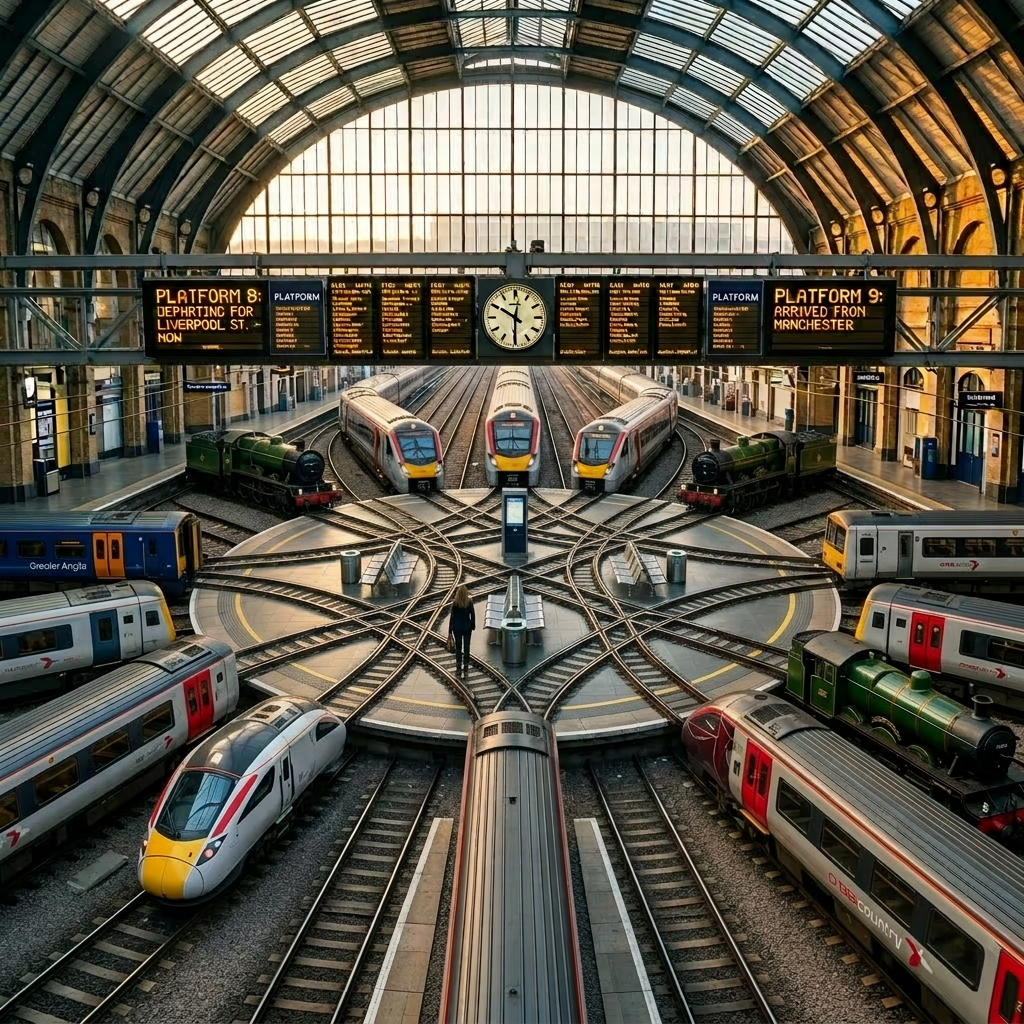
Here’s a way to think about it instead. Imagine your life as a train that never stops moving. You’re on it right now, and you always have been. Every moment is another mile of track behind you and another mile ahead. You can’t get off the train, not really. But every now and then, something on the way catches your eye. A person. A feeling. A memory. A worry. It pulls at you like a station coming into view, and you get off to take a look.
That’s fine. That’s life. The point was never to stay on the train and refuse every station, arms folded, refusing to feel anything. That’s just a different kind of gripping, holding tight to the idea of letting go instead of holding tight to a thing. The point is to actually get off, look around, let yourself feel whatever pulled you there, and then get back on when it’s time. Not clinging to the platform. Not pretending the station doesn’t exist either.
The hard part is knowing when it’s time to get back on, and finding your way back to the train once you’re standing in the middle of the station, surrounded by whatever pulled you there. This is where the breath comes in.
Your breath is moving all the time too. In, out, in, out. No breath is ever the same as the last one. It’s impermanent, just like everything else. But it’s also always there, always available, always repeating. That makes it a strange and useful kind of anchor. Not an anchor that holds you still, but one that moves with you and never fully disappears.
When you’re standing in the station, caught up in a feeling or a worry or a person you can’t stop thinking about, the breath is still there in the background, quietly reminding you that there’s a train, and it’s still running, and you can get back on whenever you’re ready. You don’t need to fight the pull of the station. You just need something steady enough to find your way back through it.
Here’s a simple practice, nothing complicated.
A few times a day, stop for thirty seconds. Don’t try to change anything about where you are or what you’re feeling. Just notice your breath moving in and out. Notice that this breath is not the last one, and the next one hasn’t happened yet. Let that be enough. If you’re in the middle of something that’s pulling at you, a hard conversation, a wave of anxiety, a memory that won’t let go, don’t try to leave it. Just breathe while you’re in it. Let the breath be the thing that tells you the train is still there, even while you’re standing in the station.
Over time, this gets easier. You stop needing to white-knuckle your way through difficult moments, and you stop needing to rush through good ones either. You learn you can visit a station fully, without moving in, because you always know how to find the platform again.
And when you are standing on the solid ground of the platform you can watch whatever trains come and go through the station.
Nothing here is asking you to feel less. It’s just offering a way to feel fully and still find your way back.

 Spiritual Gravity