

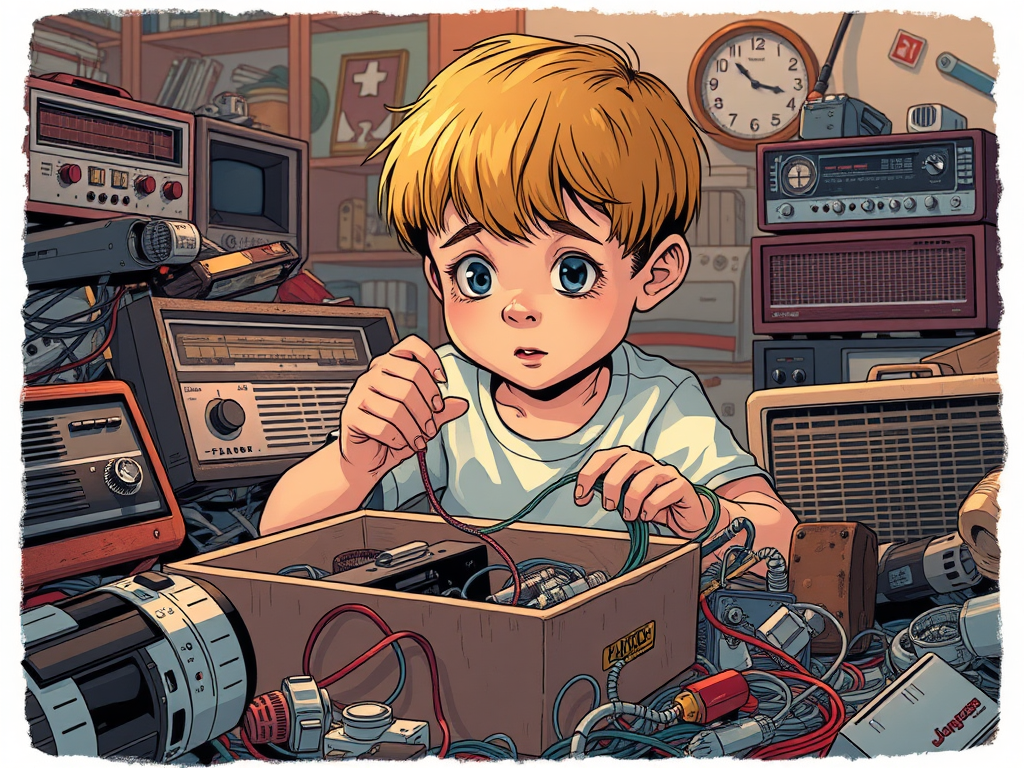
When I was a kid, I loved taking things apart. An old radio that didn’t work, a broken amplifier from my uncle Bernie, bits and pieces from around the house. I’d pull out the wires, unscrew the tiny bolts, separate the tubes, and end up with a pile of parts—some recognizable, others strange and nameless. I never tried to put them back together again. Instead, I kept them in a box, as if one day I might need them for something.
That habit never really stopped. Over time, it just shifted inward. Now, instead of radios and amplifiers, I take apart moods. I unscrew the thoughts, separate the memories, and try to find the smallest component, the raw material before it becomes something solid. A mood is just a collection of thoughts, just as a radio is a collection of parts. We call it a mood when all the thoughts work together to create a particular feeling, just as a few rods and gears in a model set can become a Ferris wheel, an airplane, or a house. But if I keep breaking it down further, what’s left?
What’s the simplest piece? The thought before it becomes a mood? The smallest part before it forms something with a name?
I try to get there—to let go of the past and the future, to be right here, now. But the momentum of everything that came before, and the weight of everything that might come next, echoes into the present and interferes. I can’t just shut it all off.
The mind doesn’t stop thinking. It runs like an engine, like an old refrigerator humming in the background—unnoticed until it stops. Sometimes, I don’t even realize the weight is there until, suddenly, it lifts. And when it does, it’s like a balloon popping—not with a rush of escaping air, but with a release into lightness. A sense of relief, of space.
The weight, the constriction—it’s all constructed in the mind. And what’s made can be unmade. The tangle of thoughts, the weaving of a mood—it can all be undone, unraveled, let go. The mind has simply been running on habit, on old conditioning. And I don’t have to keep it running.
I can pull the plug.
But stopping the whole storm at once isn’t necessary. I don’t need to battle the wind or push away the rain. I don’t need to solve everything all at once.
All I need is one breath.
Just inhale. Exhale. Not ten breaths, not even three. Just one. And if I can stay with that one breath, maybe I can do it again. One more. But always, just one at a time.
Like standing in a downpour with an umbrella, I don’t need to stop the storm—I just need to create a space where I don’t get drenched. The umbrella of one breath. That’s enough.
And as I stand under it, I begin to notice something: the storm isn’t as solid as it seemed. There are spaces between the raindrops, stillness between the gusts of wind. The weight, the constriction—it was never a solid thing. It was only ever moving parts.
One breath. Then maybe another.
But always, just one.
This one breath right now.

 Spiritual Gravity