

I keep thinking about a spacecraft using a planet as a slingshot.
If the angle is right, gravity pulls it inward, faster and faster, and then—without effort—it whips around the planet and shoots back into space with tremendous speed.
But if the angle is wrong—too steep—it doesn’t slingshot at all.
It gets captured. Pulled in. Crashes.
Nothing changes except the timing and direction of the release.
The same thing happens in a golf swing or a baseball throw. You draw the energy in, letting momentum build. The power isn’t created by forcing the release—it’s already there. The only thing that matters is when you let go. Too early and it’s weak. Too late and the motion collapses on itself.
Or think of a weight at the end of a chain. You swing it in a widening circle. The pull increases naturally. At some point, if you release it, the weight flies off with speed and precision. But you can’t steer it once it’s moving. You can only choose the moment of letting go.
David didn’t overpower Goliath.
He didn’t aim harder.
He released at the right instant.
That’s what I’m beginning to see about concentration.
When attention gathers, it pulls inward. Focus tightens. Energy builds. This is not a problem—it’s the necessary wind-up. But if the release doesn’t come, concentration turns into attachment. The mind gets captured by the planet it meant to swing around.
Earlier today, I felt this clearly. I was working on something small and became completely absorbed. At first, it was clean and fluid—everything else fell away naturally. But at some point, the release didn’t happen. I stayed pulled in. The task stopped being a movement and became a grip.
The difference wasn’t effort.
It was timing.
Healthy concentration knows how to let go.
It gathers energy and then trusts the motion.
Unhealthy concentration holds on, trying to control the outcome after the momentum is already set.
I’m starting to notice that edge—the tiny moment where things could either open and fly, or get a little too serious and stick. It’s not something I figure out. It’s something I feel, usually right as I’m about to miss it.
When the release happens on its own, everything moves easily.
When it doesn’t, things don’t fall apart—they just get heavy.
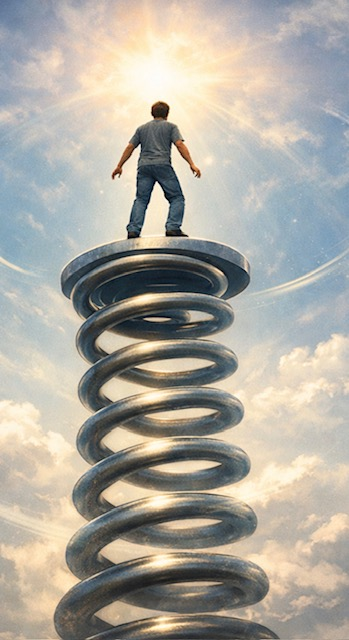
Maybe it feels like standing on a spring that’s already rising.
You don’t jump early.
You don’t wait until it drops.
You just recognize the top—
and step off just at the right moment.

 Spiritual Gravity