

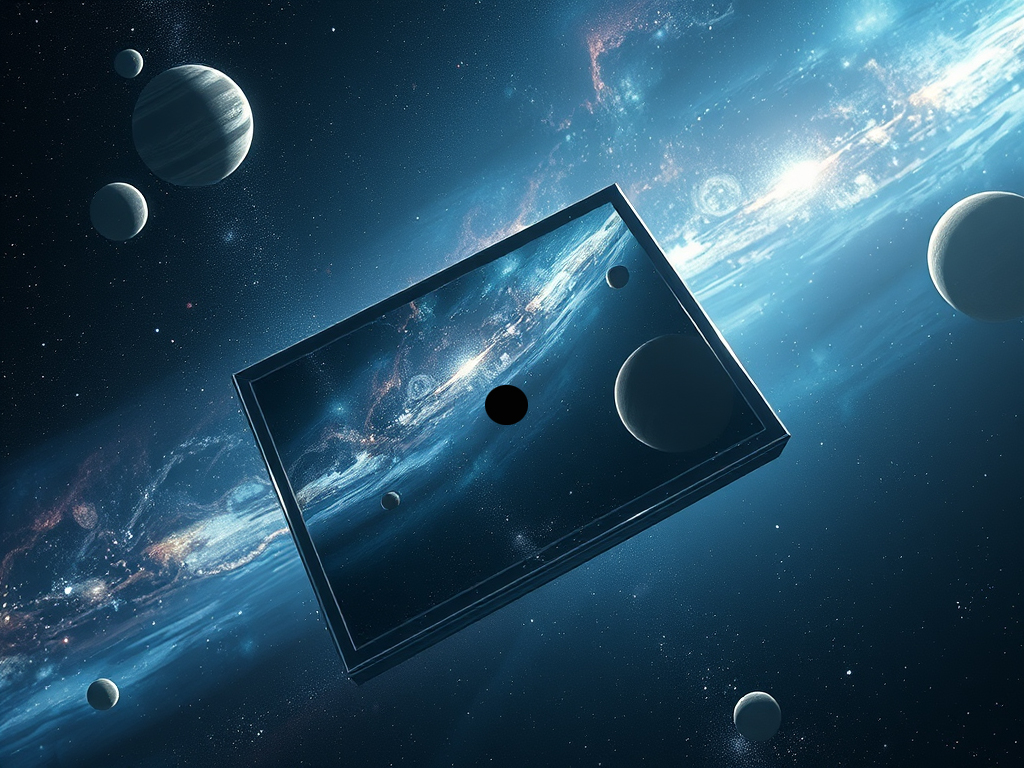
Imagine a mirror that reflects everything in front of it —
trees, faces, sunlight, clutter, beauty, fear, yesterday’s argument, tomorrow’s hope.
Every detail appears on its surface.
But in the very center of that mirror
there is a small hole — a blind spot —
a place where nothing is reflected at all.
At first, the hole is so tiny
you hardly notice it.
The reflection looks complete.
The world seems seamless.
But as the blind spot grows wider,
you begin to see a subtle interruption:
a quiet circle where no image appears.
Not darkness, not distortion —
just the absence of reflection.
Everything in front of the mirror is still there.
Nothing has been removed.
Only the reflection is absent in that one spot.
And within that unreflected opening
there is a strange kind of peace —
a calm that comes not from the world
but from the gap where the world is not mirrored.
This blind spot in the mirror
is like the blind spot on the retina
where the optic nerve leaves the eye.
It exists in everyone,
but we gloss over it,
seamlessly filling it in with imagination
without ever noticing its presence
unless we perform a little experiment
to reveal it.
Just so, in the mind:
we move through life reflecting everything —
opinions, irritations, memories, desires —
and we take these reflections to be “the whole view.”
In doing so, we overlook
the blind spot at the center of the mirror —
the opening where the ego does not reflect,
and where something universal as unbounded being quietly shines.
The conventional world fills the mirror’s surface.
But the hole — the gap —
cannot be seen by reflection.
It can only be known
when noticing stops,
when reflection softens,
when the mirror recognizes
the part of itself that does not reflect.
The blind spot is always there,
right in the center,
but we mistake the filled-in image
for reality
and forget the opening that leads back
to the unbounded being of the universal.

 Spiritual Gravity