

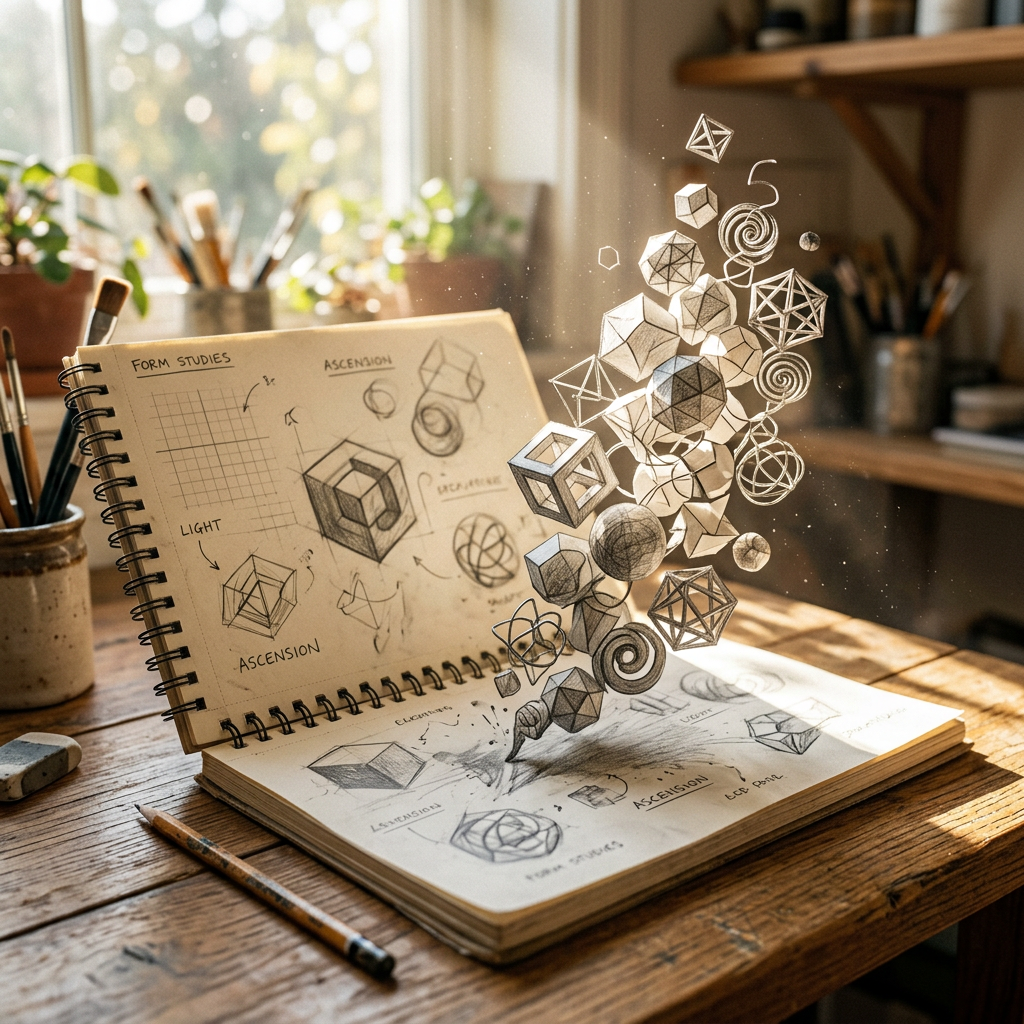
The Stick, the Microscope, and Seeing What Was Always There-Part one
Using separation to reveal what was never separate
This morning brought back a memory of Ken Baxter.
Years ago he taught a movement practice—almost like stick yoga.
He used a simple stick.
About five feet long.
About three-quarters of an inch in diameter.
Held with both hands.
Moved through different positions.
Stretches.
Rotations.
Postures.
At the time, I didn’t fully understand it.
Compared to the yoga I was doing then, it felt unnecessary.
Almost too focused on the outer form.
I thought:
Why hold a stick…
when I can simply do the posture?
And then recently, I found a piece of PVC pipe in the house—about the same size.
Without thinking too much about it, I picked it up and began moving with it.
Not as exercise.
Not as nostalgia.
Just curiosity.
And almost immediately, something felt different.
If I lift my arms without the stick…
it feels one way.
If I lift my arms in the very same position…
but now holding the stick…
it feels completely different.
The posture may look the same.
But the experience is not the same.
Because now there is an object.
Something apparently separate from me.
Something I can feel.
Something I can move with.
Something I can push against.
Something I can guide.
And suddenly I realized:
I am using duality…
to feel non-duality.
There appears to be me…
and the stick.
The mover…
and the moved.
The holder…
and the held.
And yet after a few moments, that distinction begins to soften.
The stick is no longer “out there.”
It becomes part of the movement.
Part of the sensing.
Part of the body in motion.
And that brought me back to the sketching workshop.
A sketch can work like a microscope.
Normally, thoughts, feelings, memories, images—they live in the background of awareness.
Present…
but often too subtle, too small, too blended in to be clearly seen.
Like molecules in the air.
Like bacteria invisible to the naked eye.
They are there…
but they remain part of the background.
And then a microscope changes everything.
It doesn’t create anything new.
It simply magnifies what was already there.
It separates foreground from background.
What seemed like one seamless field…
suddenly reveals detail.
Structure.
Pattern.
Relationship.
And sketching can do the same thing.
A thought that normally drifts unnoticed through the mind…
is placed on paper.
A feeling that usually blends into the day…
suddenly has shape.
A memory that lived in the background…
now has form.
And once it has form…
it can be seen.
And once it can be seen…
it can be explored.
So maybe that is what both the stick…
and the sketch…
have been teaching me.
Sometimes we use duality—
object and subject…
foreground and background…
paper and mind…
me and stick—
not to create separation…
but to finally see
what was never separate.

 Spiritual Gravity