

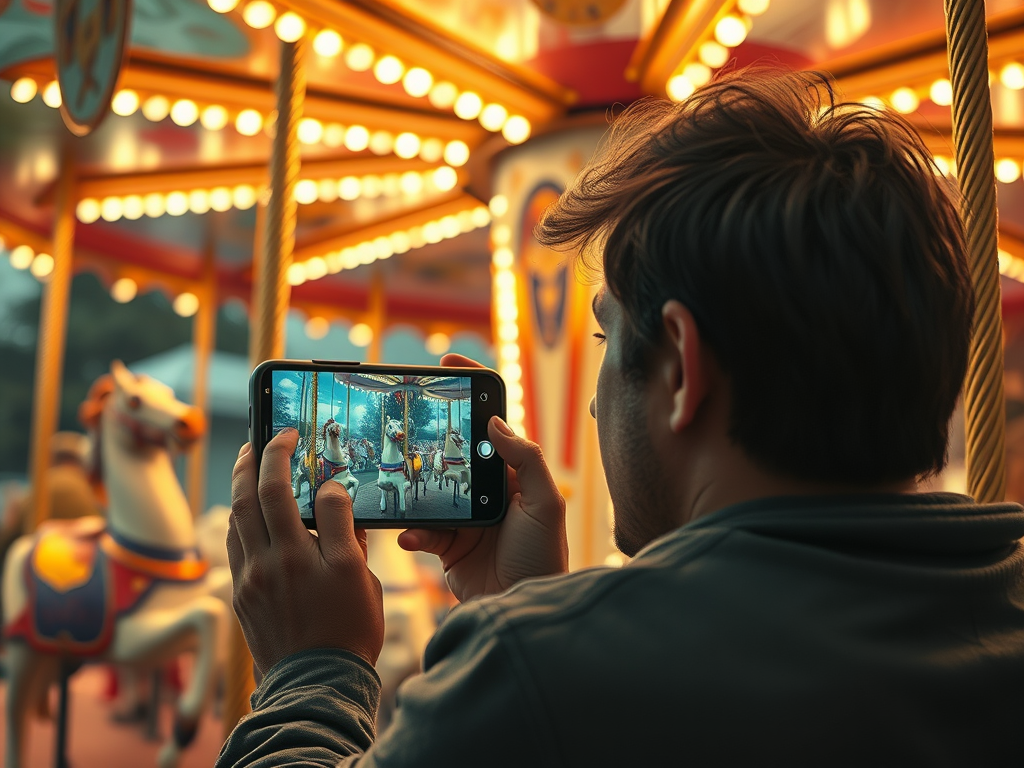
I’m on the merry-go-round with my grandchild, moving in a smooth, predictable circle. Relative to him, nothing is changing. We aren’t drifting apart or coming closer. We’re just here—rising, falling, passing the same painted horses again and again. It feels simple. Immediate. Alive.
But I’ve set up a camera on the ground, a few yards away, fixed and steady. It’s filming the ride. On my phone, I’m watching the live feed as we go around. So at the same time that I’m circling, I’m also watching myself circle.
At first, it’s mildly amusing—almost dizzying. My eyes keep jumping back and forth. One moment I’m inside the motion, feeling the pull of the turn, the wind, the rhythm. The next moment I’m outside it, watching the image glide across the screen: there I am, passing through the frame again… and again… and again.
With each lap, something subtle starts to happen. The repetition loosens the spell. The movement becomes familiar enough that it no longer demands my full attention. And in that familiarity, a small gap appears.
Am I the one going around?
Or the one watching the going-around?
The image on the screen keeps looping, frame after frame, like film running through a projector. But I begin to sense the difference between the frame and the wheel. Between the picture and the motion that carries it. The wheel keeps turning, but the frame—this single slice of the ride—can be noticed, paused, even stepped back from.
Time starts to wobble.
I feel moments stretching—just slightly—as if awareness has more room to breathe. The ride is still moving, but I’m no longer glued to its surface. I’m close enough to guide, to feel, to participate… yet far enough back to see the pattern repeating itself.
It’s not that I’ve stopped riding the merry-go-round.
It’s that I’ve stopped mistaking the frame for the ride.
And in that distinction—between wheel and frame, motion and image—awareness opens. Not dramatically. Quietly. Like discovering there’s more space in the circle than I thought, and I’ve been standing in it all along.
Acting from that vantage point feels a little like déjà vu on steroids.
You’re outside the frame—but not floating above it, not dissociated, not watching from the cheap seats. You’re right at the edge of the scene. Close enough to feel the momentum. Close enough to recognize the pattern.
It’s familiar because you have been here before—many times. You know how this usually goes. You can almost hear the line you’re about to say before it’s spoken. You can see the next beat of the story lining itself up.
But this time, you’re not inside the frame.
You’re standing just off-camera, watching the habitual response begin to form—like an actor clearing their throat before delivering a well-rehearsed line.
From here, action isn’t forced or suppressed.
It’s guided.
Not controlled in a heavy way—more like a hand on the small of the back. A nudge. A slight change in timing. A half-step to the left instead of straight ahead.
The power of this position is its intimacy.
If you move too far away, you lose contact and nothing happens.
If you step fully back in, the habit takes over.
But right here—
where familiarity meets distance—
choice becomes possible.
It doesn’t feel heroic.
It feels almost casual.
Like editing a sentence as it’s being spoken.
The scene still plays.
Life still moves.
But the script is no longer on autopilot.
That’s the twist:
freedom doesn’t arrive by escaping the movie—
it shows up when you realize you can hover at the edge of the frame,
already knowing the ending,
and decide—quietly—whether to let it run as usual
or make the smallest change that alters everything.

 Spiritual Gravity