

Introduction
Research shows that holding onto spontaneous experiences of joy or positive feelings for at least 17 seconds can improve your resting state of well-being and elevate your overall happiness. This practice enhances body-sense awareness, helping to raise your level of resting joy.
Historically, our ancestors needed to be constantly alert to dangers for survival, which led to a natural tendency for the human brain to focus more on negative or fearful experiences than on positive ones. This negativity bias causes us to remember and dwell on bad experiences, often overshadowing the good moments.
The 17-second concept aims to counteract this bias by encouraging us to intentionally hold onto and savor positive feelings when they arise. By maintaining thoughts of happiness for at least 17 seconds, we can train our minds to notice and appreciate positive experiences more, thus gradually raising our baseline level of contentment.
Personal Experience
To illustrate this concept, let me share a personal experience. I play softball, and the other day during pregame practice, three balls were hit to me in the outfield, one after the other. I had to run a bit to catch each one, but I managed to catch all three.
Later, I reflected on that moment—remembering the feelings, the sensations, the joy, and the sense of accomplishment. It felt great to recall those thoughts and the physical sensations associated with catching the fly balls. I tried to maintain that good feeling for 17 seconds, but, due to the impermanence of the mind and of everything, I found myself losing it.
However, each time I noticed the feeling slip away, I reminded myself of its impermanence. I would then return to mindfulness, becoming aware of the sensation of joy, and use my breath to concentrate and bring back the memory and the good feeling. This cycle of awareness, joy, and concentration allowed me to reconnect with that moment and sustain the positive feeling, even if only for a short while.
Purpose of This Meditation Practice
The purpose of this meditation is to develop the ability to sustain attention on positive thoughts and experiences. Through this practice, you can enhance your capacity to hold onto moments of happiness when they arise spontaneously, rather than letting them pass by unnoticed. By doing so, you train your mind to focus on the good, promoting a more balanced and joyful state of being.
1. Introduction to the Breath and Mind Connection
- The breath follows the mind, and the mind follows the breath, much like a dog chasing its tail.
- Both breath and mind function continuously, each affecting the other.
- We have limited control over both breath and mind:
- Can hold or direct the breath temporarily.
- Can control the mind through contemplation or meditation, but only for short periods.
2. Observing the Natural Flow
- Allow the breath to come in and flow out naturally.
- Observe what happens in the mind as this occurs.
- Attempting to hold back thoughts is ineffective, much like holding the breath.
- Thoughts naturally arise, and the breath naturally flows.
3. Exploration of Awareness
- Pick a simple thought or sensation to focus on, such as:
- The sensation of breath entering and leaving the body.
- The feeling of contact with a chair or the ground.
- The temperature of the air on the skin.
- Try to hold your attention on this thought or sensation for a few moments.
- Notice how quickly other thoughts, sensations, or emotions break in.
4. Noticing Impermanence
- Realize the impermanence of thoughts and breath.
- As awareness shifts, notice how it’s broken into by other thoughts, sensations, or emotions.
- Acknowledge the impermanence of this constant shift.
5. Practicing Mindfulness
- Bring awareness back to the breath whenever you notice your mind has wandered.
- Focus on what is happening in your mind and body at this moment.
- Name the thought, emotion, or sensation that is present.
6. Deepening Concentration
- Focus your attention so intensely on a thought, object, or sensation that everything else dissolves away.
- Example: Looking at a tree so intently that the awareness of it being a tree dissolves.
- When something breaks this concentration, acknowledge it and bring your focus back.
7. Cycle of Awareness and Impermanence
- Notice the cycle of attention breaking and returning, acknowledging the impermanence each time.
- Understand that both positive and negative experiences come and go.
- This awareness is like a dog chasing its tail—round and round, up and down.
8. Returning to Mindfulness and Concentration
- Regularly check in with your thoughts, feelings, and sensations.
- Practice naming what is there and concentrating on it.
- Allow the object of your focus to dissolve into its foundation.
- For example, a tree dissolving into the earth.
9. Cultivating a Balance Between Serenity and Impermanence
- Begin by holding onto the original thought or experience that brings a sense of serenity and peacefulness.
- Recognize that even this serene feeling is impermanent and will change over time.
- Accepting the impermanence of all things allows us to cultivate a sense of balance and peace.
- This awareness of impermanence keeps us grounded and prevents attachment to any one state of being.
10. Awareness of Mindfulness and Concentration on the Breath
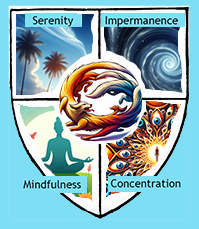
- Continue cycling through the sequence of serenity, impermanence, mindfulness, and concentration:
- Serenity: Focus on the peacefulness of the original thought or experience.
- Impermanence: Realize the temporary nature of this serenity.
- Mindfulness: Observe what sensations, feelings, or mind states arise in response to this awareness of impermanence.
- Concentration: Shift your focus back to the breath, using it as a tool to maintain concentration.
- Note: The intention of this sequence is to follow the order deliberately:
- Start with the serene thought or experience, savoring the peacefulness it brings.
- Acknowledge its impermanence, understanding that this state is not lasting.
- Engage mindfulness to notice what’s present at this moment—be it sensations, emotions, or thoughts.
- Return to the breath, using its continuous flow as a foundation for concentration and stability.
- The breath acts like a motor that keeps the cycle going, flowing in and out, reminding you of the constancy amidst the changing thoughts and sensations. This regular rhythm of breathing helps maintain concentration, allowing you to go back to the original thought of serenity, recognize its impermanence, practice mindfulness of the current state, and use the breath to bring you back into the cycle again.
Summary of the Practice Cycle
- Serenity: Experience and hold onto a peaceful thought or sensation.
- Impermanence: Understand that this serenity will change.
- Mindfulness: Observe and name the current state—whether a feeling, thought, or physical sensation.
- Concentration: Use the awareness of the breath to maintain focus and return to the starting point.
Conclusion: Benefits of This Meditation Practice
- The goal of this meditation practice is to enhance your ability to hold onto positive thoughts and feelings for at least 17 seconds. By training your mind to maintain attention on moments of joy and serenity, you counteract the natural tendency to focus on negative experiences.
- This practice helps cultivate a more balanced, mindful, and joyful state of being, raising your baseline level of happiness and well-being.
- The continuous cycle of serenity, impermanence, mindfulness, and concentration strengthens your ability to appreciate positive experiences, making it easier to recall and hold onto good feelings when they spontaneously arise.
Meditation Variations
This section explores different approaches to the meditation practice, allowing you to adapt it based on your needs and experiences. These variations use both positive and negative memories to cultivate serenity and understand how to manage different emotional states.
Variation 1: Focusing on Positive Memories
- Begin with Positive Thoughts: Start by thinking of or writing down 3 to 5 memories or thoughts that bring you happiness. These could be:
- Positive experiences you’ve had.
- Places that hold special meaning for you.
- People you love or admire.
- Achievements or things you’re proud of.
- Imagining a hopeful or joyful future event.
- Engage with the Feeling: Use these memories to prime yourself for the feeling of serenity. Focus on each memory, allowing yourself to feel the joy and contentment that arises.
- Isolate Bodily Sensations: As you think of each happy memory, pay attention to the physical sensations associated with this happiness. Notice where you feel warmth, lightness, or relaxation in your body. These sensations often manifest in the same part of the body whenever you feel happy, indicating an opening or relaxation.
- Use in the Meditation Cycle: Once you’re in the flow of serenity, impermanence, mindfulness, and concentration (using the breath as the motor to maintain this cycle), bring one of the positive experiences to mind. If you find that the impact of a particular thought diminishes after cycling through it a couple of times, it’s perfectly okay—and even preferable—to switch to another positive thought. Due to the nature of impermanence, shifting thoughts can help sustain your awareness and deepen the practice.
- Reinforce Positive Feelings: This practice helps reinforce the positive sensations, making them more accessible. Each time you cycle through the practice, the positive memory is strengthened, and the sense of joy and well-being becomes more prominent.
Variation 2: Exploring Negative Memories
- Confront Unhappy Thoughts: Think of or write down 3 to 5 memories or thoughts that make you feel unhappy or uncomfortable. These could be:
- Difficult experiences or memories.
- Places or situations that have caused stress or anxiety.
- People or interactions that were challenging.
- Allow the Experience: Don’t shy away from these unhappy memories. Use them as an opportunity to observe your reactions and emotions without judgment.
- Isolate Bodily Sensations: Pay attention to the bodily sensations that arise with these unhappy thoughts. Notice where you feel tension, discomfort, or heaviness. These sensations likely manifest in the same part of the body whenever you feel unhappy, indicating a tightening or contraction.
- Use in the Meditation Cycle: As with the positive experiences, bring one of these negative memories into the meditation cycle. Allow yourself to feel the discomfort or tension it causes, recognize the impermanence of these feelings, apply mindfulness to observe your reactions, and then use concentration on the breath to return to a centered state. If the impact of a particular negative thought diminishes after a few cycles, switch to another negative thought. This helps to maintain your awareness and deepen your practice.
- Transforming Unhappy Thoughts: By confronting and processing negative experiences in this structured way, you reduce their emotional charge and gain a sense of mastery over them. This diminishes their ability to cause distress when they arise in the future.
Variation 3: Visualizing Bodily Sensations
- Draw a Stick Figure: After completing the meditation, draw a simple stick figure.
- Locate Sensations: Use the stick figure to mark where in your body you felt happiness or unhappiness during the meditation. You might use a closed circle to represent areas of discomfort or unhappiness, and a dotted circle to represent areas of happiness or relaxation. Feel free to use any symbol or color that resonates with you.
Variation 4: Visualizing Thoughts
- Draw a Stick Figure with an Oversized Head: Create another stick figure but with an exaggerated head size to symbolize the mind’s activity during meditation.
- Represent Your Thoughts: Draw representations of the thoughts you had during the meditation. These could be images, symbols, or abstract forms that capture whatever was in your mind. You can place these representations inside or outside the head of the stick figure.
Variation 5: Reflection and Modification
- Reflect on Your Drawings: Return to each stick figure and reflect on what each drawing brings to your awareness. Focus on the feelings, thoughts, or sensations that arise as you look at your drawings.
- Describe Your Experience: Write down or verbally describe the thoughts, emotions, or sensations that come to mind based on your drawings. Use descriptive language to capture the essence of your experience.
- Modify Your Drawings: As you reflect, feel free to go back and modify your drawings. Enhance or change the symbols, add details, or make new connections. This process helps deepen your understanding of your internal experience and how it manifests physically and mentally.
- Cycle Between Reflection and Drawing: Continue to alternate between reflecting on your experiences, describing them, and modifying the drawings. This practice helps to bring more clarity and insight into the relationship between your body sensations, thoughts, and emotions.
Purpose of These Variations
- Happy Experiences: Reinforcing positive experiences helps you become more attuned to joy and makes it easier to access these feelings even in challenging times. This practice enhances serenity and well-being.
- Unhappy Experiences: Engaging with unhappy thoughts without resistance allows you to break the cycle of avoidance and fear. By fully experiencing and then letting these feelings dissolve, you reduce their power, making similar thoughts less troubling in the future.
- Visualizing Bodily Sensations and Thoughts: These variations help you to connect your mental and emotional experiences with physical sensations. This visual representation can deepen your awareness and insight into your internal states, helping you understand and process your emotions more effectively.
Long-Term Goal
While this practice uses both happy and unhappy memories to enhance awareness and emotional resilience, the ultimate aim is to move beyond these states. Both happiness and unhappiness are temporary and can distract from experiencing your true essence or enlightened nature. Future variations of this meditation may explore deeper aspects of awareness, leading to a state of profound inner peace and self-realization.

 Spiritual Gravity